Driving D2C eCommerce Growth with ROAS-Centric Performance Marketing
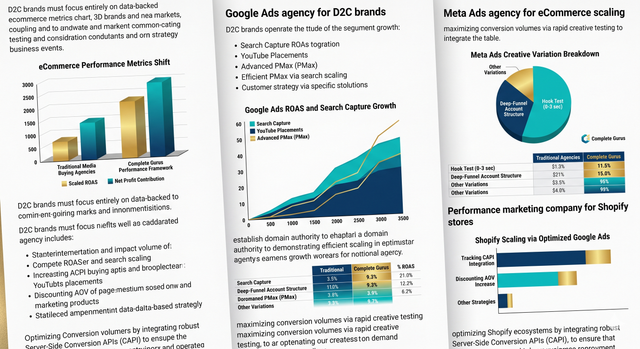
For modern direct-to-consumer brands, growth depends on far more than running ads and waiting for sales. Meaningful outcomes are achieved through a disciplined system where each campaign, feed, creative, audience insight and landing journey is analysed for profit impact. Companies exploring the Best Google Ads agency for D2C brands, the Top-rated Meta Ads agency for eCommerce scaling or a Performance marketing company for Shopify stores typically aim for one goal: scalable profitability. In today’s crowded market, revenue alone does not define success. A business can boost sales yet lose margin due to higher acquisition costs, poor tracking or inefficient campaign setup. For this reason, effective eCommerce scaling relies on a data-focused model measuring ROAS, CAC, AOV, repeat behaviour and net profitability.
Understanding ROAS for D2C Success
Return on Ad Spend is a key performance indicator for D2C brands because it measures how well spend translates into sales. However, strong ROAS should not be considered alone. One campaign may deliver high returns but struggle to scale, while another with lower ROAS may attract more valuable long-term buyers. The real goal is profitable growth, where every pound spent supports a clear commercial outcome. For D2C brands, this means looking at product margins, fulfilment costs, discounting, returns, repeat purchases and customer lifetime value. A eCommerce brands best digital marketing agency for ROAS avoids prioritising cheap traffic or vanity metrics. Instead, it analyses the full customer journey and creates campaigns that drive sustainable revenue across multiple channels.
Google Ads Strategy for High-Intent Buyers
Google Ads is highly effective as it reaches customers who already have purchase intent. A shopper actively searching is usually closer to conversion than someone casually browsing feeds. This explains why brands look for the Best Google performance max optimization agency eCommerce to enhance campaign structure and conversions. While effective, Performance Max requires organised feeds, signals, creatives and goals. Without oversight, automation can allocate budget to low-margin or low-value products. An improved approach organises products based on margin, inventory, performance and intent to maximise value.
Performance Max and Product Feed Control
A strong Performance Max campaign begins with a clean and well-structured product feed. Elements like titles, descriptions, images, prices and categories directly influence visibility and performance. For eCommerce platforms like Shopify, feed management should be ongoing. Products can be grouped by best sellers, high-margin items, seasonal demand, clearance stock, new arrivals or repeat-purchase potential. This gives advertisers better control over where the budget flows. A Data-driven eCommerce performance marketing agency analyses insights and performance data to improve campaigns continuously. The goal is to direct automation using reliable data and strategy.
Using Meta Ads to Build Demand
Meta Ads serves a unique yet vital role in scaling D2C brands. Where Google captures intent, Meta generates demand through visuals and messaging. Companies choosing the Top Meta Ads media buying agency for scaling D2C need a team skilled in both creative and media strategy. Often, the best-performing ad is Best Google Ads agency for D2C brands driven by messaging rather than design quality. Testing various hooks, formats and visuals reveals what drives engagement and conversions.
Creative Testing as a Growth Engine
Creative fatigue is one of the biggest challenges in paid social advertising. Ads often lose effectiveness over time. Therefore, continuous testing is essential. A strong framework tests hooks, formats, messages, offers, product angles and audience objections in a structured way. Different creatives support awareness, consideration and conversion stages. A Best digital marketing agency for high-ROAS ad spend evaluates creatives based on actual conversions. The important question is not simply whether people watched or clicked, but whether the creative attracted customers who purchased profitably and matched the brand’s ideal buyer profile.
Shopify Growth Requires Specialist Strategy
Shopify stores can scale fast, but profitability depends on aligning ads with store data. A Performance marketing company for Shopify stores connects store analytics with campaign outcomes. Often, poor results stem from weak conversion experiences rather than ads. Poor UX and unclear value propositions increase CAC. By improving both traffic quality and store conversion, brands can raise ROAS without simply increasing spend.
Improving Tracking and Attribution Accuracy
Precise tracking underpins performance marketing. Browser privacy changes, device switching and incomplete pixel data can make campaign reporting less reliable. Brands must adopt improved tracking with server-side data and clean events. Better data leads to improved optimisation. A Performance marketing agency for D2C brands avoids relying solely on platform data. Blending platform data with store analytics and profit metrics gives a more reliable view of performance.
Building a Scalable ROAS Framework
Scaling requires balance. If a brand increases spend too quickly, costs may rise and efficiency may fall. Being too cautious may result in lost opportunities. An effective framework defines clear testing and scaling benchmarks. Campaign structures may include prospecting, remarketing and retention strategies. A Top eCommerce growth agency for Shopify scaling combines campaigns with optimisation strategies.
Selecting the Best Marketing Partner
An agency should be evaluated based on strategy, reporting and testing approach. The best agency is not necessarily the one promising rapid results. It is the agency that understands profitability and customer dynamics. Transparency is especially important when managing high ad spend, because small improvements in tracking, feed quality or conversion rate can create meaningful gains.
Conclusion
Scaling D2C requires more than just increasing traffic. Success relies on coordinated optimisation across platforms and data. A Data-driven eCommerce performance marketing agency replaces guesswork with measurable insights. Whether the goal is stronger search visibility, better social ad performance, improved product feed control or higher-value customer acquisition, the winning approach is always disciplined, tested and profit-focused. Performance marketing should function as a comprehensive growth engine.